|
Crinum is a fascinating genus of the large and equally captivating
Amaryllidaceae family. Larger
in stature than most other species of Amaryllidaceae, most crinums
are suitable as landscape plants in or near water features while
most of the smaller species can be successfully cultivated even
in a small garden. With due care against their one major pest, crinums
are easily cultivated and provide a regular dramatic focus point
with their large, bright inflorescences.
Description
The name Crinum originates from the Greek Krinon,
which means white lily. As most species have white or whitish flowers
the name seems especially appropriate.
Crinum are herbaceous plants with large, tunicated bulbs
which produce a neck or a pseudostem made up of the sheathing bases
of the old leaves. The leaves are linear to sword-shaped, sheathing
at the base, arranged in a rosette or rarely in two opposite rows,
often dying back in winter, usually with the previous season's leaves
growing out again in spring with a few new leaves in the middle.
The inflorescences arise laterally on a long, solid peduncle (main
or inflorescence stalk) and are umbellate (flower stalks radiate
from one central point), with two spathe valves (bracts) and one
to many flowers. The flowers have short or long stalks with a long
perianth tube and linear to broadly lanceolate segments that are
spreading or held together in a trumpet shape. The stamens are either
curved, ascending or angled downwards. The ovary appears as a swelling
between the flower stalk and the tube.

The fruit are subglobose, sometimes beaked, with the persistent
remains of the tube bulging with large seeds and eventually bursting
irregularly to release the seeds. The seeds are subglobose, with
a more or less impervious, smooth or distinctly hairy seed coat.
Distribution
There are between 60 and 100 species of Crinum world-wide,
occurring in America, Africa, southern Asia to Australia. Africa
has the most species. The genus is related to a group of mostly
southern African endemic genera, constituting the tribe Amaryllideae
(Meerow & Snijman 1998). Twenty-two species are at present recognized
in southern Africa. The uncertainty about the number of species
is due to the difficulty in correctly naming species. Crinum
are particularly difficult to assess from dried herbarium sheets.
Species previously thought to be just one variable species may consist
of a number of distinct species. Thus even recent literature uses
different names for the same species (Lehmiller 1997).
There are two main groups of species, sometimes placed in subgenera
in older literature.
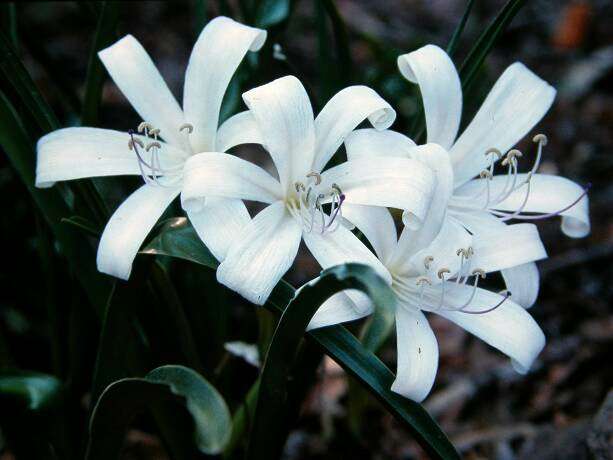
- In the first group, the flowers are radially symmetrical, with
slender or linear segments; it is cosmopolitan and is closely
associated with large seasonally flooded habitats or a few species
may even be permanently submerged in water.
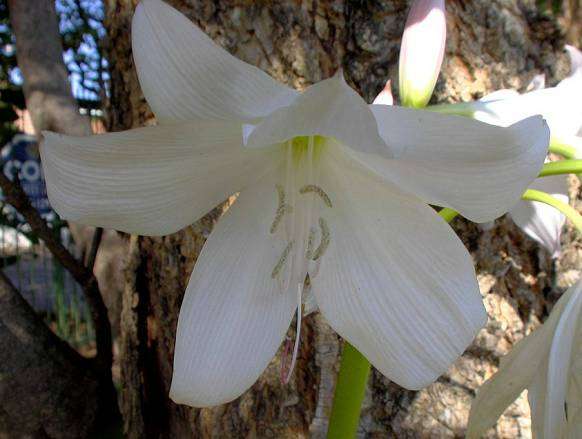
- The second group, those with a wide, funnel-shaped form and
bilaterally symmetrical flowers, is mostly restricted to Africa,
with a few in India and Australia. These species occur in a range
of habitats from pans or riverbanks, arid regions to hill slopes
or forest margins. Despite the frequent arid habitats where crinums
are found, they respond well to water and flower in masses after
the often brief rainfall period in a area. The seeds are well
adapted for water dispersal and this has clearly been responsible
for the cosmopolitan distribution of the genus.
Recent molecular analysis does not support this classification
into two groups as outlined above. (Meerow et al 2003).
Ecology
As discussed above, crinums occur in a wide range of habitats from
aquatic to desert. Each species is adapted to its specific habitat
and this should be taken into account by the gardener.
Uses and cultural aspects
Crinum species have a long history of cultivation. Many northern
hemisphere hybrids have been attempted of which one, Crinum x
powellii (presumably a cross between C. bulbispermum
and C. moorei) is still often seen in older southern African
gardens. Yet there is still much scope for the selection and development
of cultivars in the genus. Micropropagation is now a successful
option for large-scale propagation of many species of Crinum
e.g. the rare C. variabile (Fennell et al. 2001).
Throughout the world Crinum species have been used traditionally
to cure ailments and diseases. Phytochemical analysis yielded more
than 150 different isoquinoline or Amaryllidaceae alkaloids and
some of the most noted effects are analgesic, anticholinergic, antitumour
and antiviral. Recently, galanthamine has been registered as an
acetylcholinesterase inhibitor, which is an important approach in
treating Alzheimer's disease (Jäger et al. 2004). Since the
alkaloids are highly toxic, use of Crinum species is not
recommended for the novice, as a large dose could easily be fatal.
Growing Crinum
Stock of most true species rarely multiplies vegetatively by forming
offsets. If it does, it is probably a hybrid. It is best cultivated
from seed. Seeds are placed in a well-drained, sandy medium with
plenty of compost and a slow-release fertilizer such as bonemeal,
with regular watering and full sun. The high water content of the
seed enables it to germinate after a week or two, even in dry conditions.
Seed germination is hypogeal: the embryo stem is formed soon after
release and in turn produces the cotyledon and radicle below the
soil surface. Check to see that the young bulb is not pushed out
of the soil. If seedlings are kept growing throughout the winter
months, they will reach flowering size sooner. First flowering can
be expected after three (C. macowanii) to eight years (C.
graminicola). The plants perform best in a permanent position
and, like any Amaryllidaceae, do not react well to any disturbance
of the roots.
Species
The following species are selected as they are more commonly
seen in South Africa or are considered more suitable for cultivation.
However, a number of other South African or tropical species (Bryan
2002), are also worth cultivating for their unusual appearance,
e.g. C. buphanoides (distichous leaves), C. minimum (an
unusual dwarf species, Craib 1997), C. variabile (a winter
rainfall species, Fennell et al. 2001), C. asiaticum (an
attractive variegated form is available) and C. jagus (superficial
similarity to C. moorei).
|
|
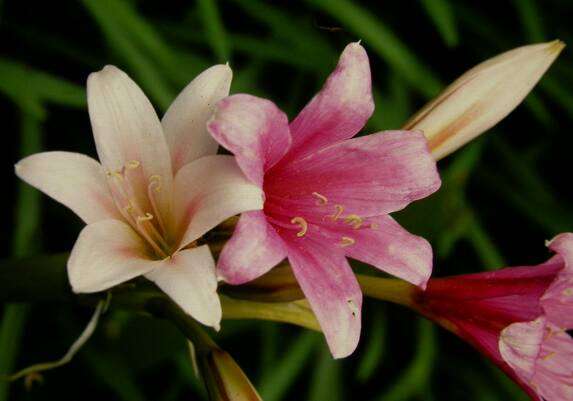
C. acaule
A dwarf species with a umbel of one or two (rarely three), comparatively
large and fleshy flowers that are strongly scented. The peduncles
are underground and therefore the fruit are usually partially
buried. The segments are white, with a pink flush, usually keeled
with deep pink. The fruit is beaked and the seeds are large,
blackish and distinctly papillose. It is a rare endemic to Zululand
in KwaZulu-Natal. The puzzling relationships between this species
and similar Namibian species needs to be re-examined critically
(Archer 1997; Archer & Condy 1999a). |
|
|
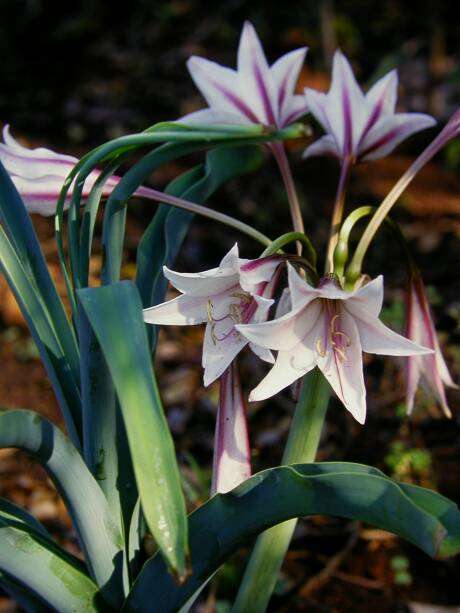
C. bulbispermum
orange river lily (Eng.), oranjerivierlelie (Afr.)
Frequently confused with C. macowanii in nurseries, the
leaves are greyish green and not the brighter green or less
glaucous (pale bluish green) colour characteristic of the latter
species. One of the largest of the South African species, the
bulb is very large and the sheathing leaves usually form a thick
false stem up to 400 mm long, glaucous green. Flowers 5 to 16,
the perianth segments form a narrow funnel shape with the apical
portion slightly recurved, white with a dark red keel or uniformly
pinkish, becoming red as the flowers fade. It occurs on the
Highveld of South Africa: Gauteng, Mpumalanga, Free State as
well as along the Orange River in the Northern Cape. They can
survive high temperatures in summer and well below freezing
in winter. This species is very variable in size and particularly
in the length of the perianth segments. Some plants with short
segments are not at all attractive. |
|
|
C. campanulatum vleilelie (Afr.)
One of the true aquatic species that needs to be placed under
water to flower. Flowers few, up to seven. The perianth is funnel-shaped,
segments are white to uniform light pink, becoming deep red
in the fading flower. Endemic to a small area in the Eastern
Cape. |
|
|
C. graminicola graslelie (Afr.)
Closely related to C. stulmannii and differs mainly in
that its fruit develops faster and is usually beaked. The peduncle
is usually relatively short and spreading. Flowers are usually
a uniform deep pink colour but many plants have flowers that
are white with a prominent, deep pink keel. This species is
unusually slow to mature, a minimum of eight years should be
expected and it flowers irregularly. Described from Gauteng
and the North-West province it also occurs in the northern parts
of KwaZulu-Natal. Plants from Limpopo and Botswana may belongs
to this species or to C. stuhlmanii. |
|
|
C. lugardiae veld lily (Eng.); veldlelie
(Afr., Du Plessis & Duncan 1989)
Despite its recorded common name, the species is more often
recorded in areas adjacent to vleis or areas subjected to brief
seasonal flooding. It is an easily grown species (though slow-growing),
but adapts well and flowers regularly in a garden. C. lugardiae
is smaller, but similar in appearance to C. macowani and
they are sometimes confused. Distribution is from Gauteng to
Namibia. |
|
|
C. macowanii Sabie crinum, Cape
coast lily (Eng.) umNduze (Zulu)
Particularly suitable for use as a landscape or garden plant.
It is probably the easiest species to cultivate owing to the
large number of seeds produced and plants can flower within
three years in optimum conditions. When flowering between October
and December, the large inflorescences with up to 25 large white
flowers present a spectacular display (Archer & Condy 1999b). |
|
|
C. moorei Natal
lily (Eng., Du Plessis & Duncan 1989), boslelie (Afr.)
A tall plant with its almost evergreen leaves emerging from
a thin pseudostem, is horticulturally most suitable for any
garden. This is the only one of the South African species which
grows and matures new leaves each season, therefore the leaf
tips are neat and not truncated as in the other species. Five
to ten flowers are born on a long, erect peduncle. The perianth
segments are white or pale pink and form a very wide open funnel,
adding to its attraction. In addition, the species prefers shade.
In most highveld gardens leaves die off after March and emerge
early in July. Flowers emerge in late summer, but plants from
Port St Johns in the Eastern Cape are recorded as flowering
in September (Batten 1986). It is possible that many of these
plants are finding their way into gardens, and plants can now
be seen flowering throughout the rainy season. The species occurs
in Eastern Cape and KwaZulu-Natal. |
|
|
C. paludosum
A smaller plant often found in large numbers in vleis. The vlei
on the Sandhof Farm in Namibia is a small natural wonder when
a million plants are in flower simultaneously. It has a scattered
distribution from KwaZulu-Natal and Mozambique, to Namibia.
The leaves are light green and gracefully arch outwards 'like
young mealies'. Flowers 5 to 11, white to pink, sometimes with
a darker pink keel. |
|
|
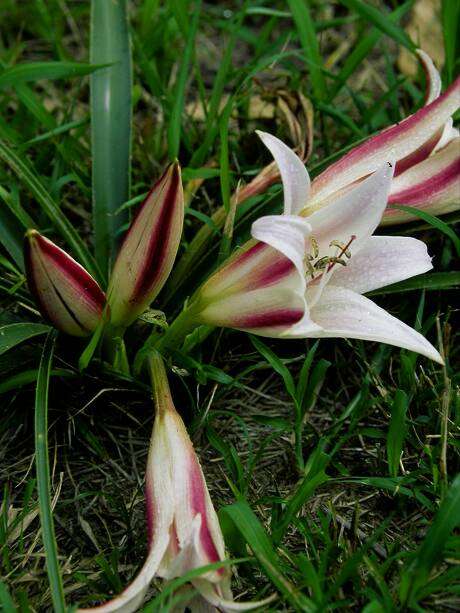
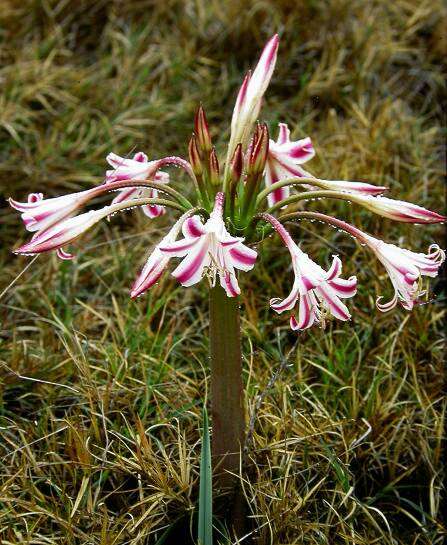
C. stuhlmannii candy-striped crinum
(Hesse 2001)
Until recently known as C. delagoense or C. forbesii
(Archer & Archer 1996; Lehmiller 1997). The species
occurs from KwaZulu-Natal to East Africa along the coastal region
and along the low-altitude Zambezi and Limpopo Valleys. The
species is similar to C. graminicola but with a long erect peduncle
and with numerous (up to 30) flowers. The perianth segment usually
has a prominent deep pink keel which gave origin to the above-mentioned
common name. The fruit is not beaked and the pericarp is thick
and fleshy, eventually turning bright red. |
In the Garden
Most species will grow well in any soil to which plenty of compost
has been added. C. campanulatum needs to be placed in a pot
in water. Plants grow best in full sun but will tolerate light shade
and will thrive in a wet part of the garden. C. moorei does
well under trees and is a most useful species for the 'dry shade'
problem. The plants will benefit greatly from occasional feeding
with liquid fertilizer and compost added to the growing medium.
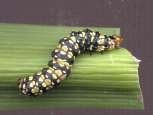 Because
of its poisonous alkaloids, its only real pest is the specifically
adapted black-and-yellow-striped amaryllis caterpillar (Brithys
pancratii) and occasionally snails and slugs, which may render
especially the thin-leaved species an unsightly mess in a short
time. However, the bulbs of large plants are seldom entirely destroyed
by the caterpillars and new leaves grow out quickly. A broad-spectrum
insecticide containing a modern pyrethrin can be used. In a garden,
the amaryllis caterpillar often necessitates regular spraying in
summer. Because
of its poisonous alkaloids, its only real pest is the specifically
adapted black-and-yellow-striped amaryllis caterpillar (Brithys
pancratii) and occasionally snails and slugs, which may render
especially the thin-leaved species an unsightly mess in a short
time. However, the bulbs of large plants are seldom entirely destroyed
by the caterpillars and new leaves grow out quickly. A broad-spectrum
insecticide containing a modern pyrethrin can be used. In a garden,
the amaryllis caterpillar often necessitates regular spraying in
summer.
Virus-infested plants, especially from large or retail nurseries
can be a problem and should be checked carefully for any symptoms.
Unfortunately it is not easy to distinguish between viruses and
some fungal diseases and any suspect plants should be destroyed
to stop the virus from spreading by root disturbance or insects.
Basal stem rot occasionally infects the plants but can be treated
with fungicides.
References and further reading
- Archer, R.H. 1997. Crinum acaule, C. minimum, and C. parvibulbosum
in southern Africa. Herbertia 52: 90-94.
- Archer, R.H. & Archer, C. 1996. Should Crinum forbesii (Lindl.)
Schult. & Shult. f. be reinstated? Bothalia 26: 153.
- Archer, R.H. & Condy, C. 1999a. Crinum acaule. Flowering
Plants of Africa 56: 36-40.
- Archer, R.H. & Condy, C. 1999b . Crinum macowanii. Flowering
Plants of Africa 56: 30-35.
- Batten, A. 1986. Flowers of southern Africa. Frandsen,
Sandton.
- Bryan, J. 2002. Bulbs. Timber Press, Portland.
- Craib, C. 1997. Crinum minimum: one of south Africa's most unusual
bulbous plants. Herbertia 52: 101-108.
- Du Plessis, N. & Duncan, G. 1989. Bulbous plants of southern
Africa. Tafelberg, Cape Town.
- Fennell, C.W. 2001. Micropropagation of the River Lily, Crinum
variabile (Amaryllidaceae). South African Journal of Botany
67: 74-77.
- Hesse, G. 2001. The crinums in my garden. Veld & Flora
87: 136.
- Jäger, A.K., Adsersen, A. & Fennell, C.W. 2004. Acetylcholinesterase
inhibition of Crinum sp. South African Journal of Botany 70:
323-325.
- Lehmiller, D.J. 1997. Synopsis of the genus Crinum (Amaryllidaceae)
in Namibia. Herbertia 52: 44-65.
- Meerow, A.W. & Snijman, D.A. 1998. Amaryllidaceae. In: K.
Kubitzki, Families and genera of vascular plants, vol.
3: 83-110. Springer-Verlag, Berlin.
- Meerow, A.W., Lehmiller, D.J. & Clayton, J.R. 2003. Phylogeny
and biogeography of Crinum L. (Amaryllidaceae) inferred from nuclear
and limited plastid non-coding DNA sequences. Botanical Journal
of the Linnean Society 141: 349-363.
|
|
Robert H. Archer
National Herbarium, Pretoria
September 2004
|
|